r e v i e w s
Prof. Dr. Ganesh Tartare
Nitin Vinchure’s abstract art:
Subtle Sensations in Abstract Pain: The Art of Nitin Vinchure
Experience | Texture | Kabir
Nitin Vinchure’s abstract painting is not merely a visual manifestation of introspective spiritual realization; it is a dense visual process woven from the intricate experiences of society, surroundings, and the contemporary human condition. The energy visible in his paintings is not birthed in a vacuum; it is conditioned by social reality, human relationships, conflict, restlessness, and the momentum of time. While there is no direct description of these experiences in his work, the texture emerging from them remains the central element of his abstract visual language.
In the philosophy of Kabir, realization is personal yet never detached from social reality. As the verse suggests:
“सुनता है गुरु ज्ञानी, गगनमे आवाज हो रही झीनी”
(Meaning: The wise teacher hears the subtle cosmic sound within the heart—a resonance perceived not by physical ears, but through self-realization.)
The subtle energy expressed in this verse occurs within the inner mind, yet it relates to the broader universe and human existence. A similar vision is found in Nitin’s art. Here, the concept of Advaita (non-duality) ceases to be merely spiritual; it becomes a force that dissolves the boundaries between the individual and society, the inner mind and the environment.
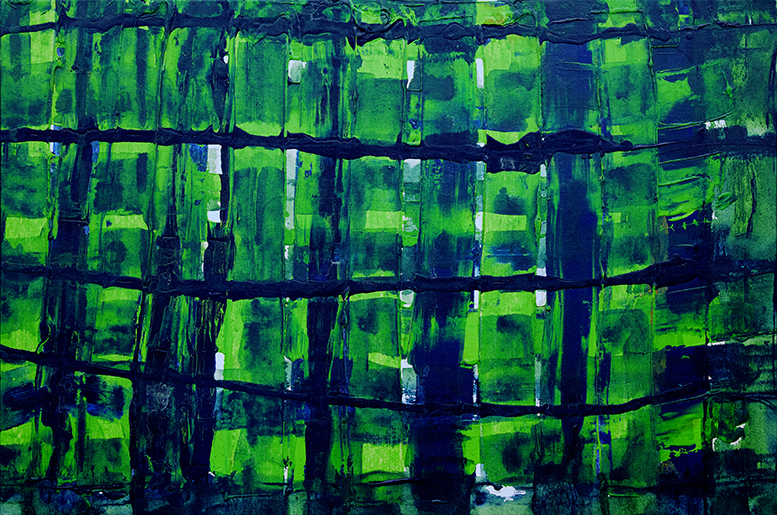
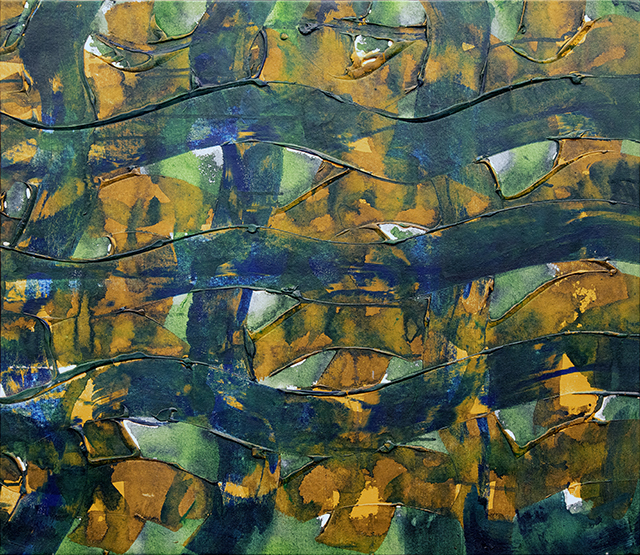
Nitin’s abstraction does not mimic visual reality, yet it does not turn its back on social reality either. Social experiences, uncertainty, dissonance, stress, and restlessness—alongside memory, hope, and internal struggle—all function subtly within his creative process. Instead of transforming into direct imagery, these experiences manifest through layers of color, the density of lines, and the roughness of surfaces. Consequently, texture in his art is not just a formal element but a carrier of content.
In Indian philosophy, the vibration or resonance (Spandan) in the pre-creation stage is considered the fundamental principle of the universe. This vibration is active in Nitin’s creative process, but it is charged with social experience rather than being purely spiritual. The strokes on the canvas do not just create beauty; they become a visual record of the tensions, fragmentation, and instability experienced in society.
The compositions—formed through vertical-horizontal, broken-continuous strokes, and the weaving of various bands—serve as a symbolic expression of a discordant social reality. There is no fixed center or final structure. This instability is the core nature of contemporary human experience. Just as an individual is trapped in constantly changing social contexts, this state is felt through the texture of his paintings.
Kabir rejects the distinction between the internal and external. For him, the walls between soul and society, or individual and universe, are artificial. This thought takes visual form in Nitin’s work. A painting is not just a reflection of the artist’s inner mind; it is an open field created through the dialogue between society and the individual. Thus, social experiences appear not as direct subjects, but in the form of texture, rhythm, and energy.
The pain in Nitin’s work is not an expression of personal grief but is linked to the collective human condition. It arises from social tension, existential restlessness, and the experience of inequality. However, it is not negative or passive. In Kabir’s philosophy, suffering is a tool for awakening; similarly, in Nitin’s paintings, pain acts as a transformative force, interlaced into the textures to become creative energy.
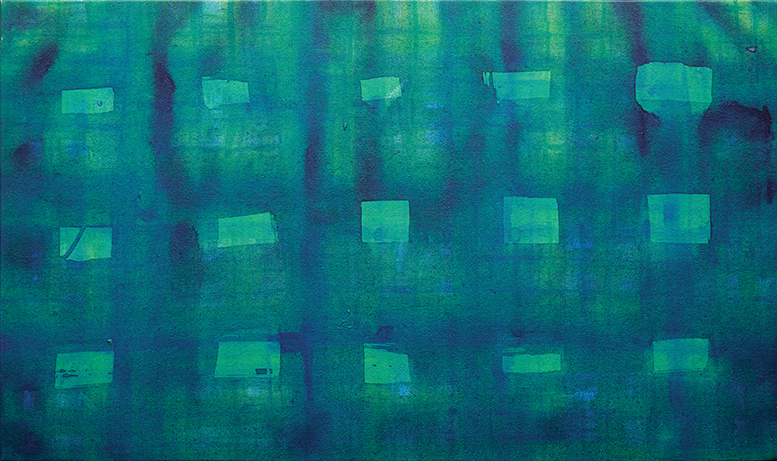
The concept of "Windows within Windows" (frames within frames) is meaningful in his process on both social and psychological levels. These windows are not just doors to consciousness but signs indicating various social experiences, contexts, and layers. One experience unfolds behind another. Therefore, his paintings have no "final" meaning; they remain perpetually open and conversational.
Nitin’s abstract art creates a space of awareness for the viewer. Standing before these works, the viewer does not just have a visual experience but engages in a dialogue with their own social experiences, memories, and internal questions. The textures and layers touch the viewer's sensibilities, making them both introspective and socially conscious.
In the context of contemporary abstract art, Nitin Vinchure’s work is not a mere formal experiment but a philosophy-driven expression charged with social sensitivity. It transcends the formal boundaries of Western abstraction and connects the Advaita perspective of the Indian Saint tradition with contemporary social experience.
- Prof. Dr. Ganesh Tartare
Artist & Art Critic